Pore-Clogging Ingredients: The List and Its Limits
By the Acnera Team (how we write) · Updated · 5 min read
Pore-clogging ingredients (also called comedogenic ingredients) are ingredients that tend to block pores and cause blackheads and whiteheads in people prone to them. Lists of them are everywhere, and they're a useful starting point. They're also less reliable than they look, because most of the ratings come from testing raw ingredients on rabbit ears in the 1970s and 80s, not from testing the finished products you put on your face.
This guide covers what's on the lists, where they came from, and a better way to find out what's clogging your pores.
The short answer
- Pore-clogging lists are a rough filter. A flagged ingredient raises the odds of a problem. It doesn't guarantee one.
- Dose and formula matter. A 2006 study in the Journal of the American Academy of Dermatology found that finished products containing comedogenic ingredients are not necessarily comedogenic.
- Heavy, oily products are the usual suspects. The AAD lists oily makeup, skin care, and hair products like pomade among things that can worsen acne.
- Your skin is the real test. Change one product at a time and watch what happens for a few weeks.
Where comedogenic ratings come from
The idea of "acne cosmetica", acne caused by cosmetics, was described by dermatologists Albert Kligman and Otto Mills in a 1972 paper. Researchers then tested raw ingredients on the inner ears of rabbits, which form clogged pores easily, and scored them from 0 (won't clog) to 5 (very likely to clog). Those scores became the 0 to 5 "comedogenic ratings" you see online today.
The problem is that rabbit ears are much more sensitive than human faces, and an ingredient tested at full strength behaves differently at 2% inside a well-formulated moisturizer. When Zoe Draelos and Joseph DiNardo re-tested finished cosmetic products on human skin, they concluded that products using comedogenic ingredients aren't necessarily comedogenic themselves.
So treat a flagged ingredient as a reason to look closer, especially if it's near the top of the ingredient list, rather than as a reason to bin the product.
Pore-clogging ingredients list
These ingredients turn up again and again on comedogenic lists. Ratings vary between sources, so we've grouped them by type instead of quoting a single number.
| Type | Ingredients that often appear on pore-clogging lists | Where you'll find them |
|---|---|---|
| Heavy oils and butters | Coconut oil, cocoa butter, wheat germ oil | Body butters, balms, "natural" moisturizers, hair oils |
| Fatty esters | Isopropyl myristate, isopropyl palmitate, isopropyl isostearate, octyl stearate | Foundations, moisturizers, sunscreens (they make formulas feel silky) |
| Lanolin derivatives | Acetylated lanolin, acetylated lanolin alcohol | Lip products, rich creams |
| Waxes and thickeners | Some forms of laureth-4, glyceryl stearate SE (in some lists) | Creams and lotions |
| Seaweed extracts | Algae extract, carrageenan (red algae) | "Marine" skincare, masks |
Hair products deserve a special mention. Oils and pomades travel from your hairline onto your forehead, and the AAD specifically names pomade among products that can worsen acne. Forehead breakouts that hug your hairline are worth checking against your hair routine.
Pore-clogging ingredients in makeup
Makeup sits on your skin for hours, so it matters more than a cleanser you rinse off. Look out for:
- Foundations and concealers heavy in fatty esters or oils, especially long-wear and "dewy" formulas
- Pressed powders with heavy binders
- Lip and cheek balms with lanolin derivatives or cocoa butter, which can cause breakouts around the mouth
The AAD recommends choosing products labeled "non-comedogenic", "non-acnegenic", "oil-free", or "won't clog pores". Those labels aren't strictly regulated, but they show the manufacturer at least considered pore-clogging.
Do pore-clogging ingredients cause acne?
They can contribute, but they're rarely the whole story. Acne starts when pores clog, and products are one of many things that can tip the balance alongside hormones, stress, sleep, and genetics. If your breakouts follow your cycle, a product swap won't fix them. See our guide to hormonal acne.
Two signs a product is the culprit:
- Timing. New blackheads or small bumps appear within a few weeks of starting it.
- Location. They cluster where the product goes, like your forehead from a hair oil or your jaw from a new foundation.
A new active ingredient like a retinoid can also bring on early breakouts for a different reason. Read purging vs breakout before you blame it.
How to check a product for pore-clogging ingredients
Reading INCI lists at the shelf is slow, and every website uses a different rating scale. A quicker routine:
- Check the first five to seven ingredients. They make up most of the formula. A flagged ingredient near the end is present in tiny amounts.
- Scan for the groups above, especially heavy oils and isopropyl esters in leave-on products.
- Patch-test it before going all in. Use it on one area, like along your jawline, for two to three weeks.
- Change one product at a time, so you know which one caused what.
Acnera's skincare ingredient scanner does the first two steps for you. Scan a product before you buy it, and it gives you a verdict on how well the ingredients suit your skin, what the product works best for, and when it's not ideal. It also flags conflicts with products you already use.
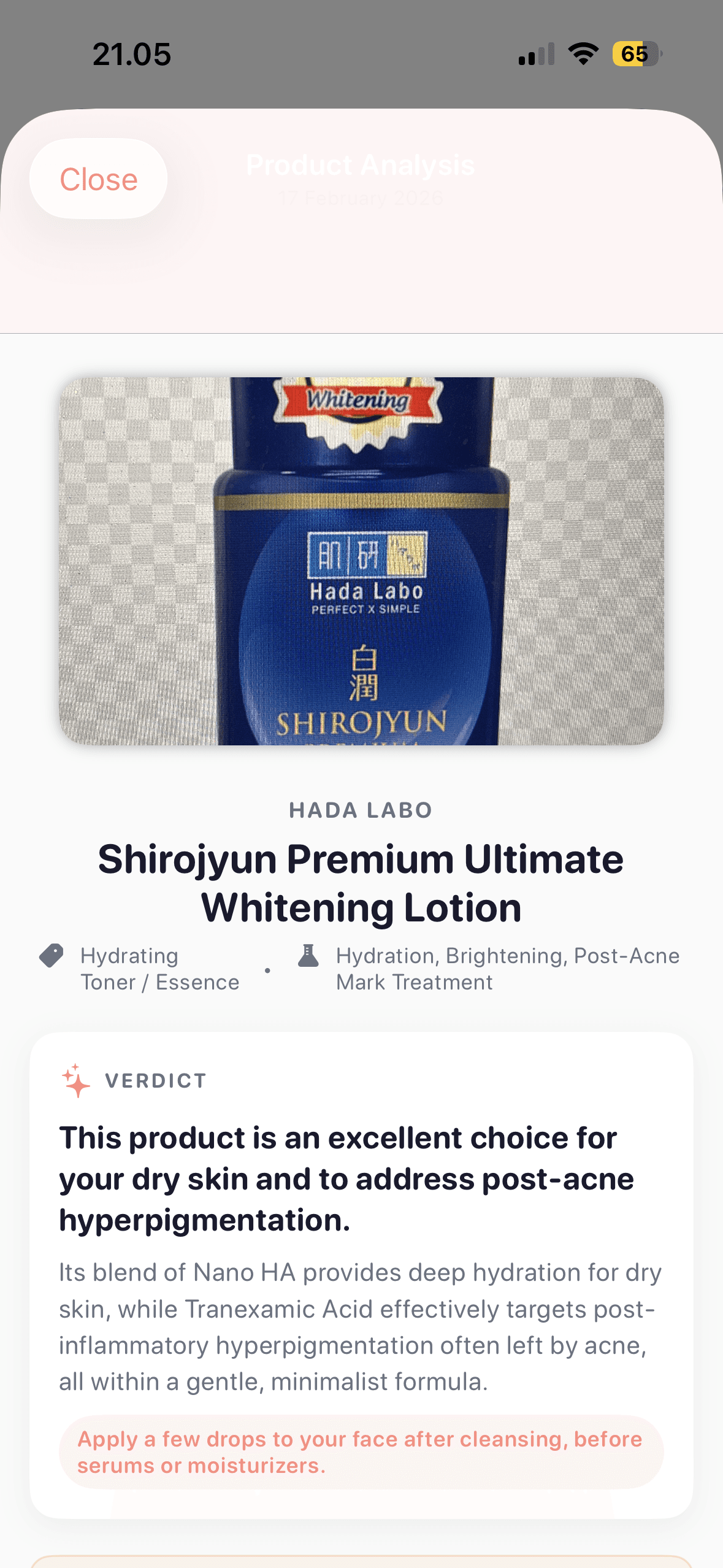
Want to check a specific product? Paste its ingredient list into the free pore-clogging ingredient checker.
Frequently asked questions
What are pore-clogging ingredients?
Pore-clogging, or comedogenic, ingredients are ingredients that tend to block pores and cause blackheads and whiteheads in acne-prone skin. Common examples on comedogenic lists include coconut oil, cocoa butter, isopropyl myristate, and acetylated lanolin.
Are comedogenic ratings accurate?
They're a rough guide. Most ratings come from testing raw ingredients on rabbit ears, which are more sensitive than human skin. A 2006 study found that finished products containing comedogenic ingredients are not necessarily comedogenic.
Is coconut oil pore-clogging?
Coconut oil rates high on most comedogenic lists, and as a heavy leave-on oil it's a common trigger for acne-prone skin. In a rinse-off cleanser at a low concentration, it's much less likely to cause problems.
Does "non-comedogenic" mean a product won't break me out?
No guarantee. The label isn't strictly regulated, but the American Academy of Dermatology still recommends choosing products labeled non-comedogenic, oil-free, or "won't clog pores" if you're acne-prone. Your own skin's response is the final test.
What should I look for in makeup if I have acne?
Choose foundations and concealers labeled non-comedogenic or oil-free, check the first few ingredients for heavy oils and isopropyl esters, and remove makeup fully every night. Patch-test new products along your jawline for a couple of weeks before using them all over.
How long does it take for a product to clog pores?
New clogged pores from a product usually show up within a few weeks of starting it. That's why it helps to change one product at a time and take photos, so you can link a breakout to the right product.
This article is for general education and isn’t medical advice. If your acne is severe, painful, scarring, or not improving, see a board-certified dermatologist.