Acne Scars vs Dark Spots: How to Tell Them Apart and What Fades Them
By the Acnera Team (how we write) · Updated · 5 min read
The difference between acne scars and dark spots is texture. Run a finger over the spot. If it is flat, it is almost certainly a mark, not a scar, and marks usually fade on their own. If the skin dips in or rises up, it is a scar, and scars rarely go away without treatment. The American Academy of Dermatology puts it plainly: flat spots left after acne are usually not scars.
That is good news for most people, since most post-acne marks are the flat kind. The catch is patience. A flat dark spot can take 6 to 12 months to fade.
The short answer
| Dark spot or red mark | Acne scar | |
|---|---|---|
| Feels | Flat, same texture as the skin around it | Dented in or raised |
| Color | Red or pink on lighter skin; brown or bluish gray on medium to darker skin | Can be skin-colored, darker, or lighter |
| Fades on its own? | Usually, within 6 to 12 months | Rarely goes away completely |
| What helps | Sunscreen, time, and treatments that speed fading | Procedures from a dermatologist |
Dark spots and red marks after acne
When a pimple heals, the inflammation can leave extra color behind. Dermatologists call this post-inflammatory hyperpigmentation (PIH). The AAD explains that on lighter skin the spot is usually red or pink, while people with medium or darker skin often see a brown spot, which can also look bluish gray. You may also see the red version called post-inflammatory erythema (PIE).
These marks are especially common in darker skin. The AAD notes that anyone with medium-to-darkly pigmented skin may see a dark spot when a pimple, cyst, or nodule clears, and that these spots can linger for months. For many people with skin of color, the spots last much longer than the acne and bother them more.
How long do dark spots take to fade?
The AAD says a spot a few shades darker than your skin usually fades within 6 to 12 months. If the color sits deep in the skin, often looking slate blue to gray, fading can take years.
That timeline is why progress feels so slow. You can clear your acne in two months and still look at its leftovers for another six.
What makes dark spots fade faster
- Sunscreen every day. The AAD says daily sunscreen can prevent new dark spots and help existing ones clear.
- Keep treating the acne. Every new pimple can leave a new mark. Fewer breakouts means fewer spots to fade. The AAD's advice is to treat acne early and keep treating it.
- Don't pick. Picking inflames the skin further, and the AAD notes that even mild acne can scar when picked.
- Ask about ingredients that target color. Several treatments are studied for post-acne marks. In a 2024 randomized trial of 72 people with mild to moderate acne, 15% azelaic acid gel twice daily for 12 weeks improved both red and dark post-acne marks compared with a placebo gel. A dermatologist can suggest others for your skin tone.
Acne scars
Scars form when a deep pimple damages the skin as it heals. The AAD sorts them into two groups by what went wrong with collagen, the protein that gives skin its structure:
Depressed scars
These form when your skin makes too little collagen to fill the area. They come in three shapes:
- Ice pick scars: narrow, deep holes.
- Boxcar scars: wider dents with sharp edges.
- Rolling scars: broad, wavy dips that make the surface look uneven.
Raised scars
These form when your skin makes too much collagen while healing. They include hypertrophic scars, keloids (which can grow beyond the original spot), and papular scars.
Do acne scars go away?
Rarely on their own. The AAD says that while acne scars can fade, they rarely go away completely. Treatment can make them much less visible.
How dermatologists treat acne scars
Scar treatment usually happens in a dermatologist's office. The AAD lists these options:
- Depressed scars: laser resurfacing, chemical peels, fillers, microneedling, radiofrequency, dermabrasion, and scar surgery. For mild scarring, a retinoid or salicylic acid applied to the skin can help. See the AAD's full list.
- Raised scars: corticosteroid injections, lasers, prescription medicine applied to the scar, and, for keloids, freezing or surgery.
The AAD says scar treatment typically begins after you have acne under control, since active breakouts keep making new scars.
How to prevent marks and scars
- Treat acne early. The AAD notes that the more severe the acne, the more likely it is to scar.
- Hands off. Picking makes spots last longer and raises the risk of scars and dark marks.
- Wear sunscreen daily, especially while marks are fading.
- See a dermatologist for deep, painful acne. Scars form when deep breakouts heal, and those breakouts usually need more than over-the-counter products.
Track the fade
Six to twelve months is too long to judge by memory, and you will see your face every day, so change is hard to notice. Take a photo every couple of weeks in the same light and compare month to month. Our guide to acne progress pictures shows how.
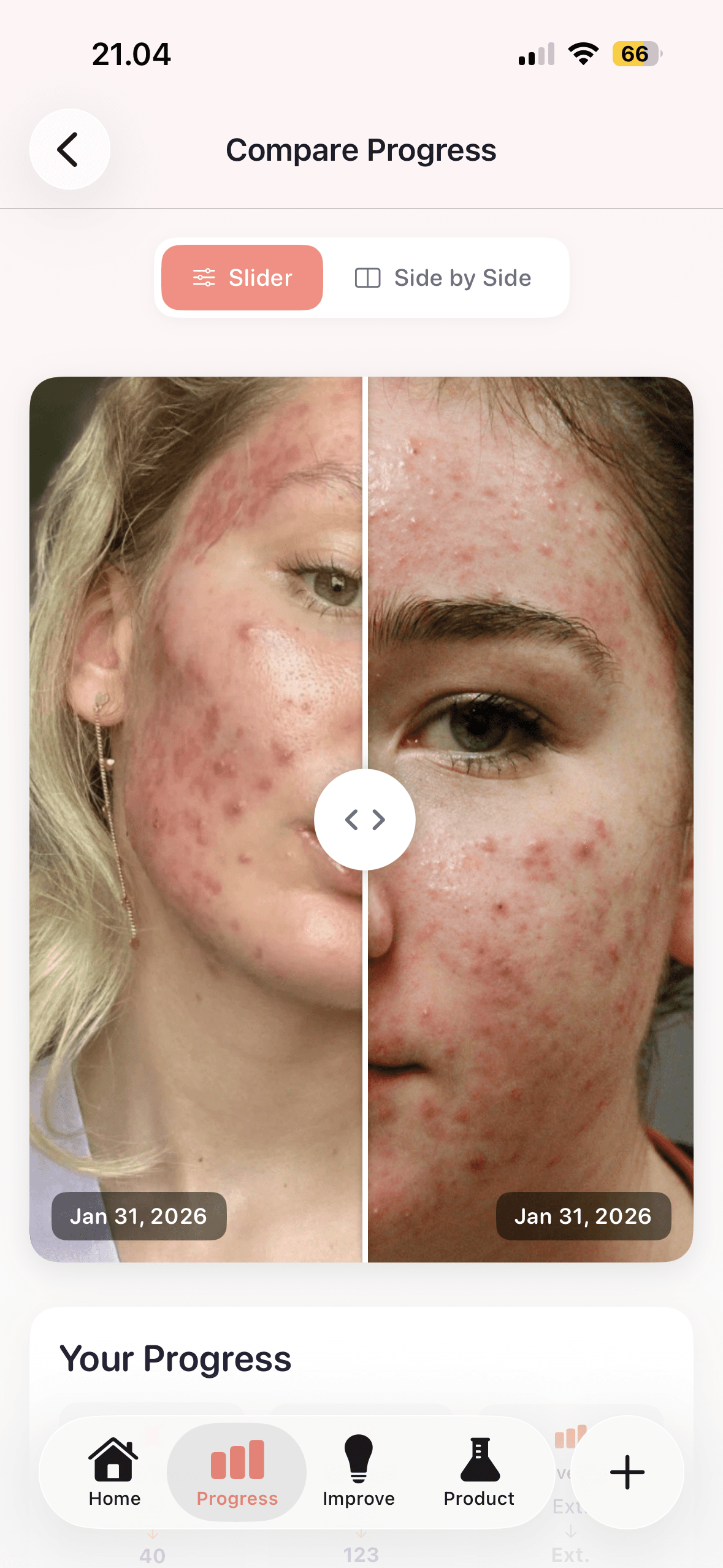
Acnera's AI scan flags visible dark spots and redness by face zone, and its before and after slider lines up photos with your face, so you can see marks fading while you wait. It can't tell a mark from a scar for certain. If you aren't sure, a dermatologist can tell in seconds.
Frequently asked questions
How do I know if it's an acne scar or a dark spot?
Feel it. A dark spot or red mark is flat. An acne scar is dented in or raised. The American Academy of Dermatology says flat spots left after acne are usually not scars.
How long do acne dark spots take to fade?
A spot a few shades darker than your skin usually fades within 6 to 12 months, according to the American Academy of Dermatology. Deeper color, often slate blue to gray, can take years.
Are red marks after acne scars?
Usually not. Flat red or pink marks are common on lighter skin and tend to fade over time. If the skin is dented or raised, it's a scar.
Do acne scars go away on their own?
Rarely. Acne scars can fade a little, but they rarely go away completely without treatment such as lasers, chemical peels, fillers, or microneedling from a dermatologist.
What fades acne dark spots fastest?
Daily sunscreen, clearing the acne so new spots stop forming, and not picking. Some treatments, such as azelaic acid, have been studied for post-acne marks. A dermatologist can suggest options for your skin tone.
Can you treat acne scars while you still have acne?
Dermatologists usually treat the acne first. The American Academy of Dermatology says scar treatment typically begins after acne is under control.
This article is for general education and isn’t medical advice. If your acne is severe, painful, scarring, or not improving, see a board-certified dermatologist.