Adult Acne: Why You're Still Breaking Out in Your 20s, 30s, and 40s
By the Acnera Team (how we write) · Updated · 5 min read
Adult acne is acne that continues past your teens or starts for the first time as an adult. It is far more common than most people think. In a survey of 1,013 adults, about half of women in their 20s and more than a third in their 30s said they had acne. The American Academy of Dermatology says some adults keep getting acne well into their 30s, 40s, and even 50s.
If you thought you would be done with this by now, you are in good company. It is also very treatable, though what works at 32 can differ from what worked at 15.
The short answer
- How common it is: about 51% of women and 43% of men aged 20 to 29 reported acne in one survey, falling to about 15% of women and 7% of men over 50.
- Who gets it most: women, at every age after the teens.
- Common causes: hormone changes, stress, pore-clogging products, some medicines, and family history.
- What works: the same core treatments as teen acne, benzoyl peroxide and retinoids, plus hormonal options a dermatologist can prescribe.
How common is adult acne?
The best-known numbers come from a 2008 survey published in the Journal of the American Academy of Dermatology. Researchers asked 1,013 adults aged 20 and older whether they currently had acne.
Two things stand out. Acne fades with age but doesn't vanish on a schedule, and women reported it more often than men in every age group, with the gap biggest in the 30s and 40s. The study relied on people's own reports rather than a doctor's exam, so treat the exact percentages as estimates.
What causes acne in adults?
The basic mechanism is the same as in teenagers: pores clog with oil and dead skin, and inflammation follows. What changes is why your pores are clogging now. The AAD lists these common causes of adult acne:
Hormone changes
Androgens drive oil production, and shifts in hormones around periods, pregnancy, perimenopause, and starting or stopping birth control can set off breakouts. The AAD notes adult-onset acne is most common in women going through menopause. In a survey of adult women with acne, 65% said their acne got worse with their period. Our hormonal acne guide covers the cycle side in detail.
Stress
The AAD says researchers have found a relationship between stress and acne flare-ups. Stress raises androgens and cuts into sleep, which both feed breakouts. More in our stress acne guide.
Products on your skin and hair
Adults often use more products than teens: foundation, richer moisturizers, hair oils. The AAD suggests choosing products labeled "non-comedogenic", "oil-free", or "won't clog pores". Our list of pore-clogging ingredients explains what to look for and the limits of those lists.
Medicines
Acne is a side effect of some medicines. If you suspect a prescription, the AAD's advice is to keep taking it and talk with the doctor who prescribed it.
Family history
The AAD notes some people have a genetic tendency to acne. If close family members had acne as adults, that may raise your odds too.
An underlying condition
Sometimes acne is a sign of a medical condition. Acne alongside irregular periods, extra facial or body hair, or thinning scalp hair is worth raising with a doctor, since these can point to conditions such as polycystic ovary syndrome.
How adult acne is different
Many adults notice breakouts around the chin, jawline, and mouth, often in step with their cycle. Your skin may also be drier than it was at 16, so a treatment that worked then can now leave you flaky and irritated. Starting at a lower strength helps.
Dark marks are another difference. The AAD notes that dark spots after acne more commonly develop in people with darker skin tones, and those spots can last much longer than the acne itself. Our guide to acne scars vs dark spots covers how to tell them apart and fade them.
How to treat adult acne
Start with one proven treatment
The AAD's advice for adults is to choose one product and use it for 6 to 8 weeks without adding another. It lists three active ingredients for at-home care:
- Benzoyl peroxide: start with 2.5%, which is less likely to dry and irritate.
- Salicylic acid: works best on blackheads and whiteheads.
- Adapalene: a retinoid that helps clear blackheads, whiteheads, and pimples. See how to use adapalene.
Not sure which suits your breakouts? Our benzoyl peroxide vs salicylic acid guide walks through it. The AAD says to expect fewer breakouts in 4 to 8 weeks and clearing around 16 weeks after starting.
Ask about hormonal options
For acne that tracks your cycle, the 2024 AAD guidelines include hormonal treatments: combined birth control pills, spironolactone, and clascoterone cream. All need a prescription.
If you are pregnant or trying to be
Check with a dermatologist before using acne treatments. The AAD notes that some non-prescription acne products aren't safe during pregnancy.
When to see a dermatologist
The AAD says to see a dermatologist if you aren't getting clear skin within a few months, and that with a dermatologist's help virtually every case of acne can be controlled. Go sooner if your acne is painful, deep, or leaving scars.
Find your own pattern
Adult acne usually has a reason you can find with a few weeks of notes. Log your cycle, stress, sleep, and any new products, and take a face photo every few days in the same light. After two or three cycles, you will see whether breakouts land in the same week, after stressful stretches, or after a product change.
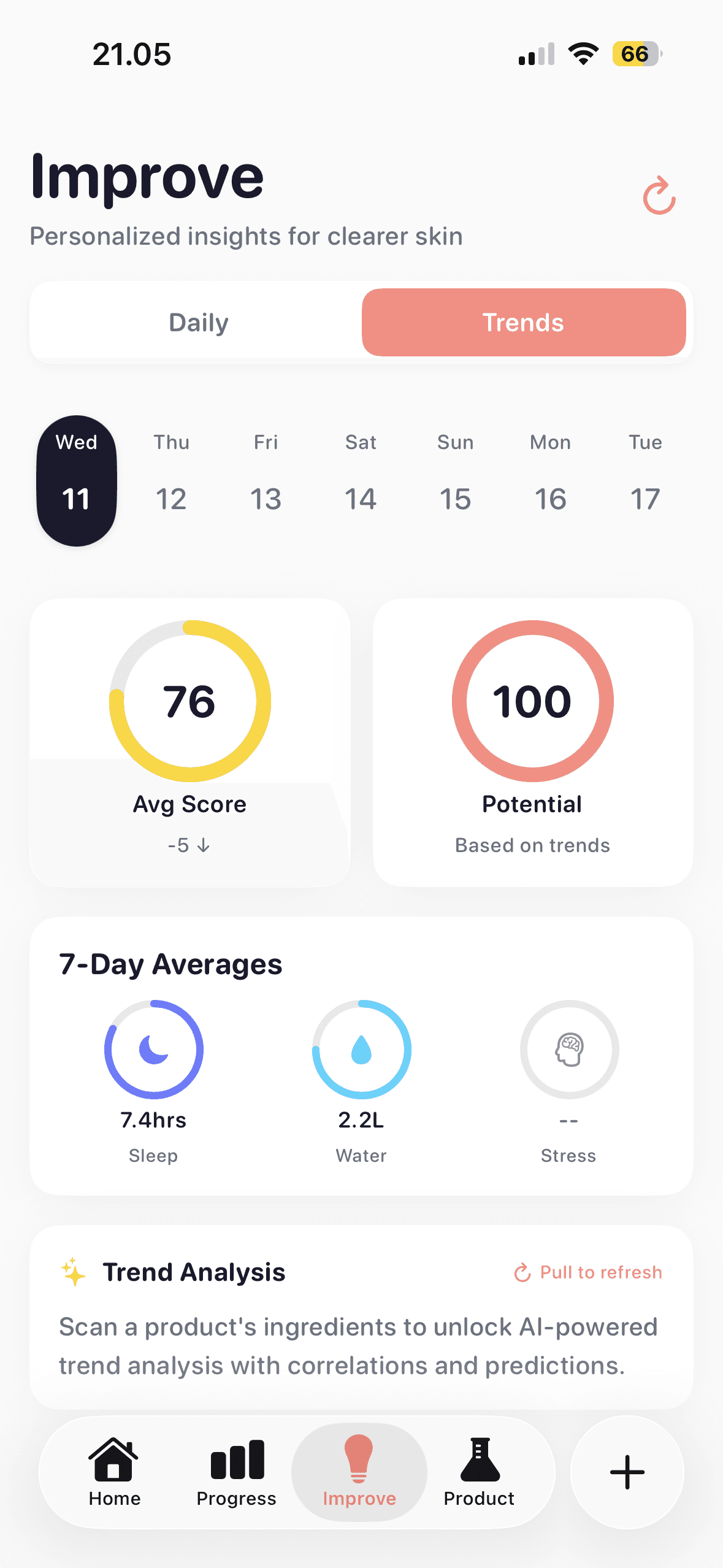
Acnera does that in one place. The daily check-in logs your cycle, stress, sleep, and water in a few taps, and trends line those up against your skin score. When you see a dermatologist, you can show them dated photos instead of trying to remember.
Frequently asked questions
Is it normal to have acne in your 20s and 30s?
Yes. In a 2008 survey, about half of women and 43% of men in their 20s reported acne, and more than a third of women in their 30s. The American Academy of Dermatology says some adults get acne well into their 40s and 50s.
Why am I getting acne as an adult when I never had it before?
Acne that starts in adulthood is called adult-onset acne. Common triggers include hormone changes, stress, new skin or hair products, and some medicines. It is most common in women going through menopause.
Why do women get more adult acne than men?
Women's hormone levels shift with periods, pregnancy, birth control, and menopause, and those shifts can trigger breakouts. In surveys, women report acne more often than men at every age after the teens.
What is the best treatment for adult acne?
Start with one proven treatment, such as 2.5% benzoyl peroxide or adapalene, and use it for 6 to 8 weeks. For acne that follows your cycle, a dermatologist can prescribe hormonal options such as birth control pills or spironolactone.
Does adult acne ever go away?
It often improves with age, but there is no fixed point. Survey data show acne becoming less common with each decade, and treatment can control it at any age.
Where does adult acne usually appear?
Many adults notice it on the lower face, around the chin, jawline, and mouth. Location alone can't tell you the cause, so track timing too.
This article is for general education and isn’t medical advice. If your acne is severe, painful, scarring, or not improving, see a board-certified dermatologist.