Stress Acne: What It Looks Like and How to Treat It
By the Acnera Team (how we write) · Updated · 5 min read
Stress acne is a flare of regular acne during or after a stressful stretch. Stress doesn't create acne from nothing, but the American Academy of Dermatology says it may worsen existing acne, and that acne gets more severe as stress increases. If your skin falls apart every exam season or deadline week, that's the pattern.
The good news is that stress acne responds to the same treatments as any other acne. The bad news is that "just relax" is not a skincare plan, so it helps to know what's going on.
The short answer
- What it is: a stress-triggered flare of ordinary acne.
- Why it happens: stress raises androgen levels, which drive oil production, and often cuts into sleep.
- What it looks like: your usual acne, more of it, often a few days into or after a stressful period.
- How to treat it: standard acne treatments such as benzoyl peroxide and retinoids, plus protecting sleep and routine while stressed.
How stress causes acne
The AAD explains that in response to stress, your body produces more androgens, the hormones that enlarge oil glands and increase oil. More oil means more clogged pores.
Sleep is the second path. In a 2026 study of college students, stress was linked to acne directly and also indirectly, by making sleep worse. Short sleep is itself linked to worse acne, so a stressful week often hits your skin twice.
Then there's behavior. Stressed people skip routines, pick at spots, sleep in makeup, and touch their faces more.
What the research shows
- Exam stress: in a 2003 study of university students, acne got worse during exams compared with calmer periods, and the change in acne tracked closely with how stressed students felt.
- Medical students: in a 2017 study of 144 female medical students, higher stress scores strongly correlated with more severe acne.
- College students: the 2026 study found stress raised the odds of acne both directly and through poorer sleep.
All of these studies show association, so they can't prove stress causes a given breakout. But the pattern is consistent across very different groups of people.
What does stress acne look like?
Stress acne looks like your normal acne. It's the timing that gives it away: more breakouts than usual during or shortly after a stressful period, in the places you usually break out.
Stress acne on the face: is there a "stress zone"?
You'll see charts claiming stress acne shows up on a specific part of the face. There's no good research behind face mapping. Stress tends to worsen acne wherever you normally get it.
Does stress acne itch?
Acne isn't usually itchy. If your stress breakout itches and the bumps all look the same, especially on your forehead, chest, or back, it could be fungal acne, which sweat and heat can also trigger.
Stress acne vs hormonal acne
They overlap, because stress works partly through hormones. The difference is the trigger you can see:
| Stress acne | Hormonal acne | |
|---|---|---|
| Timing | Follows stressful periods | Follows your menstrual cycle or a hormonal change |
| Predictable? | Only if you can predict stress | Often, from month to month |
| Who gets it | Anyone | Anyone, but cycle-linked flares are common in women |
| What to track | Daily stress level and sleep | Period dates |
Many people have both. If you're stressed in the week before your period, your skin gets two triggers at once. Our hormonal acne guide covers the cycle side.
How to get rid of stress acne
Treat the acne
Stress acne is acne, so use proven acne treatments. The 2024 American Academy of Dermatology guidelines strongly recommend benzoyl peroxide and topical retinoids. Start one at a time, and expect 6 to 8 weeks before judging results.
Protect your routine during stressful weeks
A stressful week is the worst time to start new products or skip old ones. Keep a minimum routine you can do half-asleep: cleanser, your one acne treatment, moisturizer, and sunscreen in the morning. The AAD warns that trying new acne treatments too often can irritate skin and cause more breakouts.
Protect your sleep
Sleep is the part of stress you have the most control over. The CDC recommends 7 or more hours for adults and 8 to 10 for teens.
Don't pick
Picking makes spots last longer and leaves dark marks that can take 6 to 12 months to fade.
See a dermatologist if it's severe
If stress flares leave painful lumps or scars, a dermatologist can prescribe stronger treatment. Acne that hurts your confidence counts as a good reason to go too.
Does stress acne go away?
Often, yes, once the stressful period passes. In the 2003 exam study, acne was worse during exams than outside them. If your acne stays bad weeks after the stress has ended, treat it as regular acne rather than waiting it out.
Prevent the next flare: track your stress
Stress flares feel random until you write them down. Rate your stress from 1 to 5 each day, log your sleep, and take a face photo every few days. After a month, you'll know whether your skin follows your stress, your cycle, or neither.
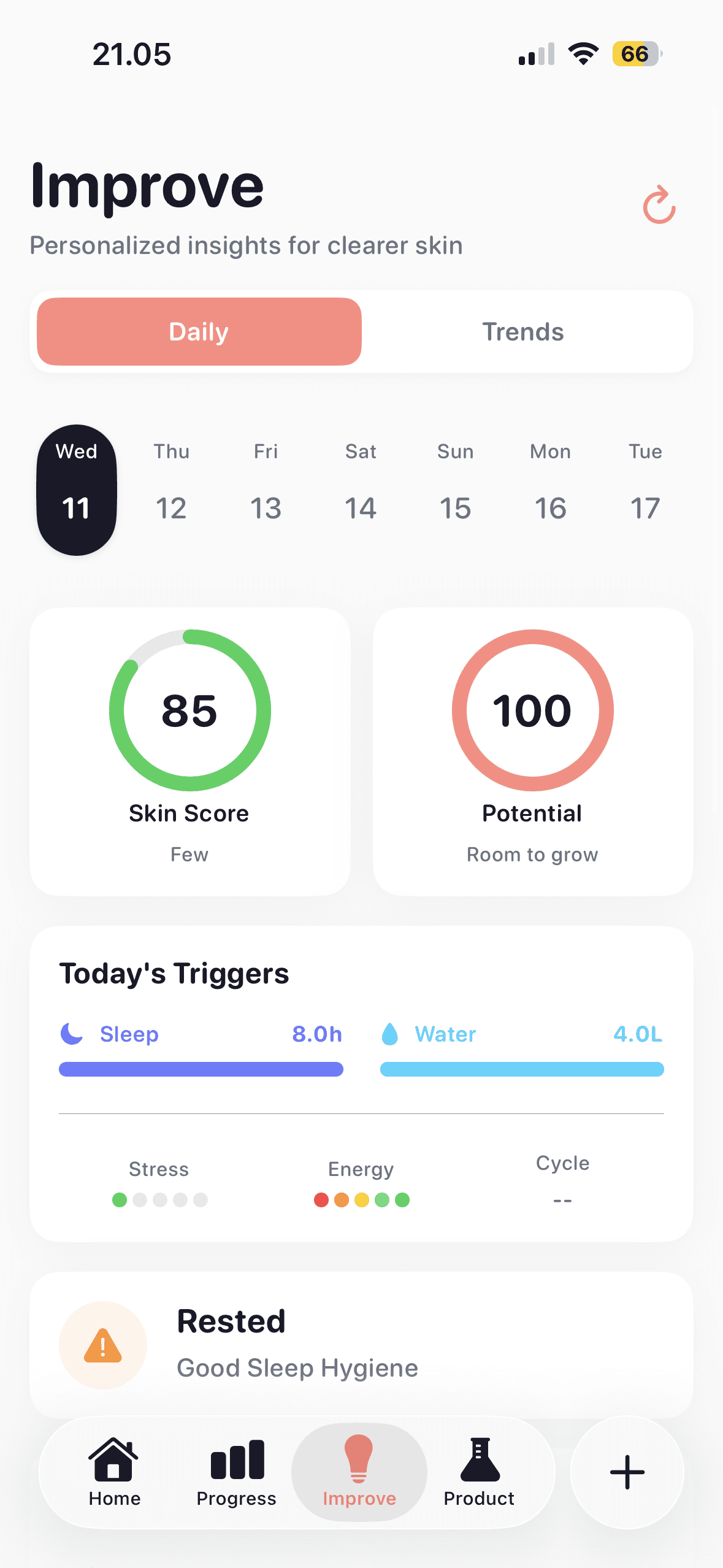
Acnera's daily check-in logs stress, energy, sleep, water, and your cycle in a few taps, and the Improve tab shows today's triggers next to your skin score. When a big week is coming, you'll know to protect your sleep and keep your routine boring.
Frequently asked questions
What is stress acne?
Stress acne is a flare of regular acne during or after a stressful period. Stress raises androgen levels and often cuts into sleep, which can increase oil production and breakouts.
What does stress acne look like?
It looks like your usual acne, just more of it, appearing during or shortly after a stressful time. There's no reliable evidence that stress acne shows up in a specific area of the face.
How do you get rid of stress acne?
Treat it like any acne, with proven treatments such as benzoyl peroxide or a topical retinoid, and give them 6 to 8 weeks. Keep a simple routine during stressful weeks, protect your sleep, and avoid picking.
Does stress acne go away on its own?
It often improves once the stressful period ends. If acne stays bad for weeks afterward, treat it as regular acne, and see a dermatologist if it's painful or scarring.
Is it stress acne or hormonal acne?
Look at the timing. Stress acne follows stressful stretches, while hormonal acne follows your menstrual cycle or hormonal changes like starting or stopping birth control. Many people have both, and stress itself raises androgen levels.
Does stress acne itch?
Acne usually isn't itchy. Itchy, uniform bumps, especially on the forehead, chest, or back, may be fungal acne, a different condition that needs antifungal treatment.
This article is for general education and isn’t medical advice. If your acne is severe, painful, scarring, or not improving, see a board-certified dermatologist.