Does Sleep Affect Acne? What the Research Actually Shows
By the Acnera Team (how we write) · Updated · 5 min read
Does sleep affect acne? Probably, yes. People with acne report worse sleep than people without it, and the worse their acne, the worse their sleep tends to be. Nearly all of this research is correlational, though. Nobody has shown that sleeping more will clear your skin.
So test it on your own face instead of taking anyone's word for it, including ours.
The short answer
- Poor sleep and acne show up together. Several studies link worse sleep quality with more severe acne.
- Stress is tangled up in it. Stress worsens acne, and part of that effect seems to run through poorer sleep.
- It works both ways. Acne can disrupt sleep, through discomfort, anxiety, or stress about your skin, as much as sleep may affect acne.
- Cause and effect isn't proven. The best you can do is track your own sleep against your skin.
What the studies found
People with acne sleep worse
In a 2023 case-control study in Sleep and Breathing, 81 people with acne had worse sleep quality scores than 76 people without it. Within the acne group, more severe acne went along with worse sleep, a later "night owl" body clock, and more anxiety and depression symptoms.
A smaller 2019 study of 40 adults with acne found that 30 of them (75%) had poor sleep quality on a standard questionnaire. As acne got more severe, sleep scores got worse, even after accounting for mood and quality of life.
Stress makes acne worse, and sleep is part of the path
For the full picture on stress itself, see our stress acne guide.
The classic study here followed university students through exam season. In Chiu et al., 2003, acne got worse during exams, and the increase in acne tracked closely with how stressed students felt.
A 2026 study of college students took this a step further. Stress was linked to higher odds of acne directly, and also indirectly by making sleep worse. In other words, stress may hurt your skin partly by wrecking your sleep.
The link runs both ways
A 2025 review in Dermatology Practical & Conceptual pulled the research together and described the relationship as bidirectional. Acne is associated with poor sleep, insomnia, and stress, while sleep deprivation may worsen acne through hormonal shifts, inflammation, and immune changes. The authors also noted that more research with standardized measures is needed.
Why sleep might affect your skin
Researchers' leading explanations, none fully proven yet:
- Stress hormones: short sleep and stress go hand in hand, and stress hormones are thought to influence oil production and inflammation.
- Inflammation: sleep loss is linked to more inflammation throughout the body, and acne is an inflammatory condition.
- Behavior: when you're exhausted, you're more likely to skip your routine, sleep in makeup, or touch your face.
That last one is unglamorous but real. A great retinoid can't work if it's on your shelf instead of your face.
Does sleeping late cause acne?
Possibly, but it's not settled. The 2023 study above found that a more "evening" body clock was associated with more severe acne. That's an association, not proof, and night owls often get less sleep overall. If you're a late sleeper, focus on getting enough sleep and keeping your timing consistent before worrying about the clock itself.
What about water?
"Drink more water" is probably the most-repeated acne tip online, and we couldn't find good-quality trials showing it clears acne. Staying hydrated is good for you. Just don't expect a gallon a day to do the job of a retinoid.
How much sleep do you need for clearer skin?
There's no acne-specific number. The general target is the one the CDC recommends: 7 or more hours a night for adults, and 8 to 10 hours for teens aged 13 to 17. If you're consistently under that and your skin is struggling, sleep is a cheap thing to fix first.
Test it on your own skin: a 4-week sleep experiment
Studies tell you what's true on average. You want to know what's true for you.
- Keep your skincare routine the same for the whole experiment. If you change products at the same time, you won't know what worked. If you've just started a new active, rule out purging first.
- Log your sleep every morning: hours, and whether it was a good or bad night.
- Log the other usual suspects: stress level, your cycle if you have one, and anything unusual.
- Take a face photo every few days in the same light and from the same angle.
- After four weeks, compare. Do bad-sleep weeks line up with flare-ups a few days later?
Acnera does this in one place. The daily check-in logs sleep, water, stress, energy, and your cycle in a few taps. The trend analysis then compares those habits with your skin score, so you can see whether your breakouts follow your sleep or something else entirely.
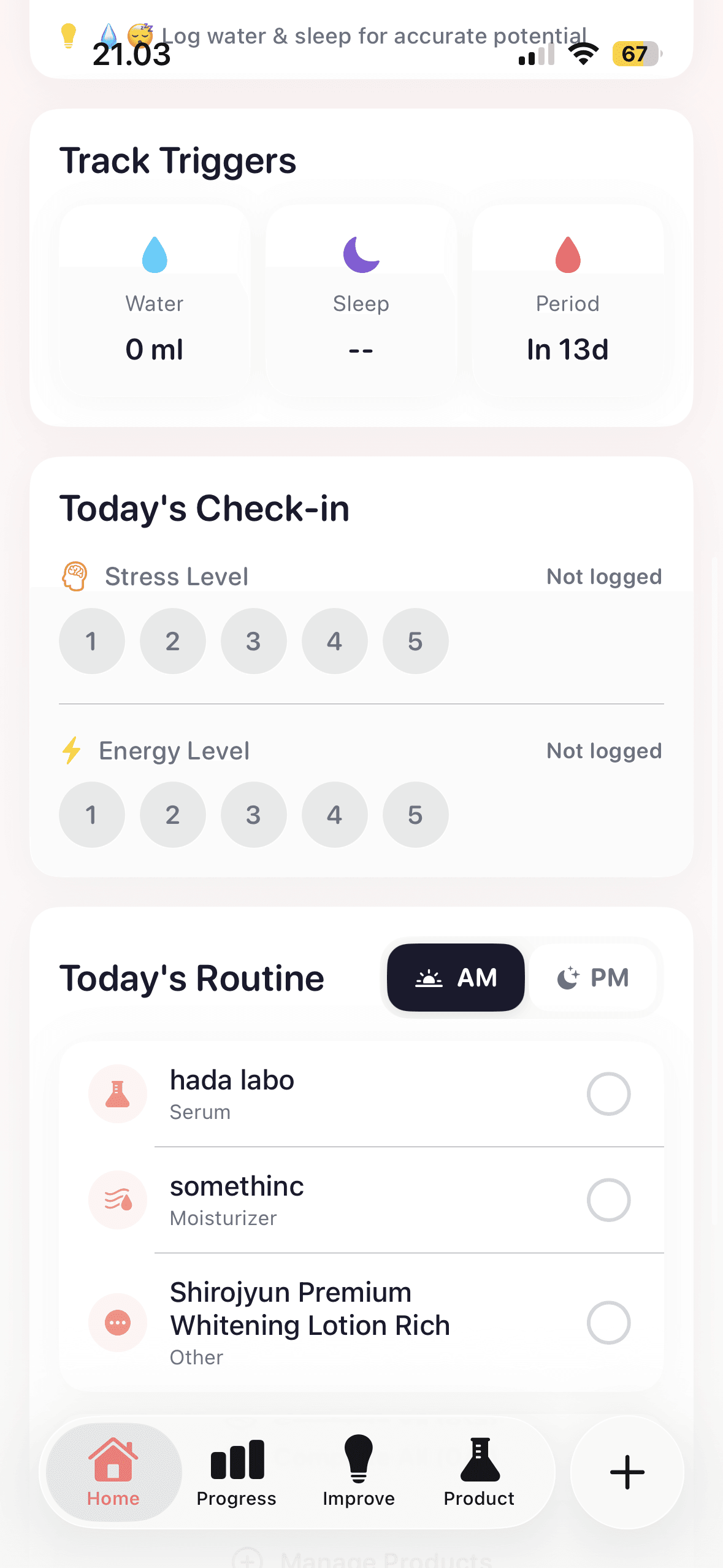
If the experiment points to sleep, great: you've found a free fix. If it doesn't, you've ruled out a suspect, and it may be time to look harder at the ingredients in your routine.
Frequently asked questions
Can lack of sleep cause acne?
Lack of sleep is linked to worse acne in several studies, and it's tied up with stress, which is known to worsen acne. But the research is correlational, so it hasn't been proven that sleep loss alone causes acne. Tracking your own sleep and skin is the best way to find out if it matters for you.
Can one bad night of sleep cause a breakout?
There's no good evidence that a single bad night causes a breakout. Patterns matter more than one night. Several weeks of short sleep, often alongside stress, is the more likely culprit.
Does stress acne go away?
Stress-related flares often settle once the stressful period passes, as seen in studies of students after exams. If your acne stays bad well after the stress ends, treat it as regular acne and consider seeing a dermatologist.
Where does stress acne appear?
There's no reliable evidence that stress acne shows up in a specific zone of the face. "Face mapping" charts aren't backed by good research. Stress tends to worsen acne wherever you normally get it.
Does drinking water help acne?
Staying hydrated is healthy, but there's little good-quality evidence that drinking more water clears acne. Treat it as general health advice, not an acne treatment.
How many hours of sleep is good for your skin?
There's no acne-specific target. The CDC recommends 7 or more hours for adults and 8 to 10 hours for teens aged 13 to 17, which is a sensible goal if your skin is struggling.
This article is for general education and isn’t medical advice. If your acne is severe, painful, scarring, or not improving, see a board-certified dermatologist.