Skincare Ingredients Not to Mix (and Rules to Ignore)
By the Acnera Team (how we write) · Updated · 7 min read
There are only a handful of skincare ingredients not to mix, and most of the scary "never use X with Y" lists online are overstated. Most irritation comes from stacking too many strong actives at once, until your skin barrier waves a white flag.
Your bathroom shelf is not a chemistry set, even if it's starting to look like one. Below is what clashes, what's fine, and how to check the products you already own.
The quick answer
Don't layer these at the same time: tretinoin with benzoyl peroxide, retinoids with exfoliating acids (AHAs or BHAs), and vitamin C with benzoyl peroxide.
These are fine together: niacinamide with vitamin C, niacinamide with retinol, hyaluronic acid with basically anything.
Rule of thumb: one strong active per routine is plenty. Split the rest between morning and night, or alternate nights.
Skincare ingredients that don't mix: the cheat sheet
| Combination | Verdict | Why | What to do instead |
|---|---|---|---|
| Tretinoin + benzoyl peroxide | Don't layer | Benzoyl peroxide plus light breaks down tretinoin fast | Benzoyl peroxide in the morning, tretinoin at night, or switch to adapalene |
| Retinol or retinoid + AHA/BHA | Don't layer | Both speed up exfoliation, so irritation stacks up | Alternate nights |
| Vitamin C + benzoyl peroxide | Separate | Benzoyl peroxide is an oxidizer; vitamin C is an antioxidant that's easily oxidized | Vitamin C in the morning, benzoyl peroxide at night |
| Vitamin C + AHA/BHA | Separate if sensitive | Two low-pH products in a row can sting | Vitamin C in the morning, acids at night |
| Retinol + vitamin C | Fine, just split | No proven chemical clash, but both can irritate | Vitamin C in the morning, retinol at night |
| Niacinamide + vitamin C | Fine | The "they cancel out" claim comes from old lab work using heat | Layer away |
| Niacinamide + retinol | Fine | A common, well-tolerated pairing | Layer away |
| Hyaluronic acid + anything | Fine | It's a humectant, not an active | Layer away |
Looking for one specific combination? The ingredient pairing chart has a page for each of 22 common pairs, with a routine that uses both.
Retinoids and benzoyl peroxide: the one clash with hard data
If there's one pairing that deserves its reputation, it's this one. In a 1998 study in the British Journal of Dermatology, researchers mixed tretinoin gel with a benzoyl peroxide lotion and exposed it to light. More than half the tretinoin degraded in about two hours, and 95% was gone within 24 hours.
The same study found adapalene stayed stable in the same conditions. That's why you can buy adapalene and benzoyl peroxide combined in one product, but you'll rarely see tretinoin and benzoyl peroxide in the same tube.
So:
- On tretinoin? Keep benzoyl peroxide to your morning routine, or use a benzoyl peroxide wash you rinse off.
- On adapalene? You can use them together, but watch for dryness.
- On over-the-counter retinol? It's a gentler cousin of tretinoin. Splitting it from benzoyl peroxide is the safe default.
Both ingredients are first-line acne treatments (if you are choosing between benzoyl peroxide and salicylic acid instead, see benzoyl peroxide vs salicylic acid). The American Academy of Dermatology's 2024 acne guidelines make strong recommendations for benzoyl peroxide and topical retinoids. The goal isn't to choose one. It's to stop them from cancelling each other out.
Retinol and exfoliating acids: an irritation problem, not a chemistry problem
AHAs (glycolic, lactic, mandelic acid) and BHAs (salicylic acid) loosen dead skin cells. Retinoids speed up how fast your skin renews itself. Use them in the same routine and you're asking your skin to shed from two directions at once.
The usual result is redness, stinging, flaking, and a damaged barrier that breaks out more easily, with no chemical reaction involved. The AAD puts it plainly: trying too many acne treatments can irritate your skin and cause breakouts.
What to do: retinoid on some nights, acid on others. If your skin is sensitive, give it a night off with neither.
Can you use salicylic acid and glycolic acid together?
Plenty of products already combine them at low strengths, and that's usually fine. What causes trouble is layering a separate strong glycolic toner over a separate salicylic serum. If you want both, alternate them or pick one product that contains both. Our guide to what not to mix with salicylic acid covers every common pairing.
Vitamin C: mostly a timing issue
Vitamin C (L-ascorbic acid) is an antioxidant that works best in the morning under sunscreen. Retinoids work best at night. Splitting them lets each one work at the right time without irritating your skin twice. There's no dangerous reaction involved.
The one pairing worth separating is vitamin C with benzoyl peroxide. Benzoyl peroxide is a strong oxidizer, and vitamin C is famously easy to oxidize. Even if there's no harm to your skin, there's a good chance you're wasting an expensive serum.
Niacinamide and vitamin C: the myth that won't die
You've probably read that niacinamide and vitamin C cancel each other out or turn into something irritating. That idea traces back to older lab experiments where the pure ingredients were combined at high temperatures. As this dermatologist-reviewed explainer points out, your products sit at room temperature, not on a stove.
Use them together. If you do get flushing, use them at different times of day, but you don't need to treat them as enemies.
Duplicate actives hiding in your products
Most "ingredients not to mix" guides talk about ingredients, but you apply products, and clashes hide inside their ingredient lists (so can pore-clogging ingredients):
- A "brightening toner" that turns out to contain glycolic acid, used right before your retinol serum
- An acne spot treatment with salicylic acid, layered over a salicylic acid cleanser and a BHA serum
- Two "glow" products that both contain strong acids, so you're exfoliating three times a night without realizing it
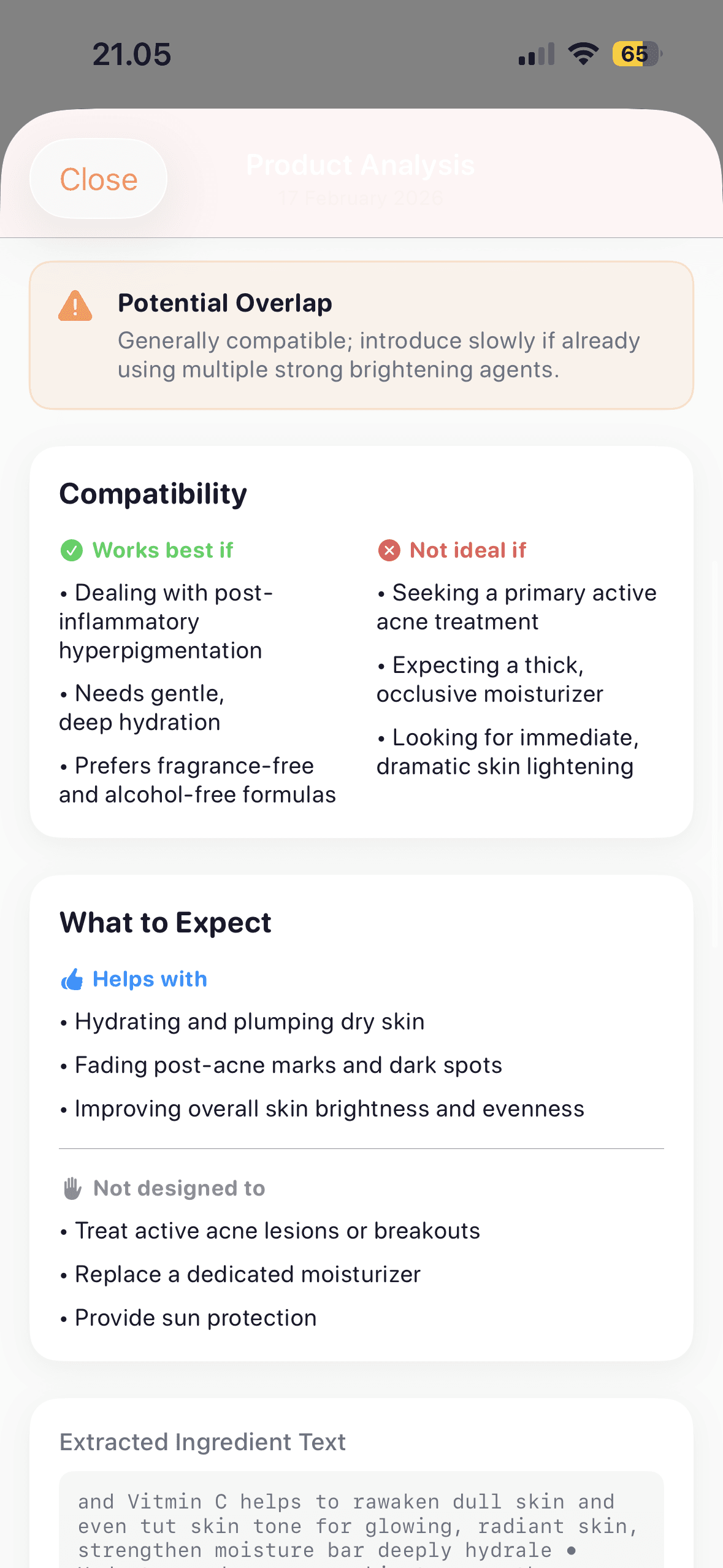
This is the most common way people end up irritated, and it's almost impossible to catch by reading labels at 11pm. It's also exactly what we built Acnera's Product Conflict Checker to do. Scan the products you use, and it flags overlaps and clashes across your whole routine, not just one bottle.
How to build a routine that doesn't fight itself
- Pick one main active for acne. Usually a retinoid or benzoyl peroxide (or adapalene with benzoyl peroxide).
- Put antioxidants in the morning. Vitamin C and sunscreen.
- Put retinoids at night. Alone or with a plain moisturizer.
- Add exfoliating acids on non-retinoid nights. Only if you need them.
- Change one thing at a time and give it a few weeks. The AAD notes it can take several weeks to a few months to see a difference.
If you're not sure whether a new product is helping, irritating, or making you purge, take a photo in the same light each week. Memory is a terrible before-and-after tool.
And if your skin flares no matter what's on your shelf, the cause may not be a product at all. Sleep and stress can play a role too.
To check your own combination, tick your actives in the free skincare ingredient conflict checker, or build a full morning and night plan with the routine order builder.
Frequently asked questions
Can you use vitamin C and retinol together?
Yes, but most people do better splitting them: vitamin C in the morning with sunscreen and retinol at night. There's no proven reaction between them. Splitting them puts each where it works best and lowers the chance of irritation.
Can you use niacinamide and retinol together?
Yes. Niacinamide and retinol are a common, well-tolerated pairing, and you can layer them in the same routine. If your skin is new to retinol, start slowly regardless of what you pair it with.
What should you not mix with benzoyl peroxide?
Don't layer benzoyl peroxide with tretinoin, because benzoyl peroxide plus light degrades tretinoin quickly. It's also worth keeping it away from vitamin C serums. Adapalene is the exception: it stays stable with benzoyl peroxide, and the two are sold combined.
Can you use salicylic acid and glycolic acid together?
At low strengths in a single product, usually yes. Layering separate strong salicylic and glycolic products tends to over-exfoliate, so alternate them instead, and skip both on nights you use a retinoid.
Can you use niacinamide and vitamin C together?
Yes. The idea that they cancel each other out comes from old lab experiments that heated the pure ingredients together. At room temperature in normal products, they're fine to layer.
Can you use retinol and azelaic acid together?
Many people do, and azelaic acid is generally gentle. If you're new to either one, introduce them a few weeks apart so you can tell which one your skin is reacting to.
This article is for general education and isn’t medical advice. If your acne is severe, painful, scarring, or not improving, see a board-certified dermatologist.