Purging vs Breakout: How to Tell the Difference
By the Acnera Team (how we write) · Updated · 5 min read
The difference between purging vs breakout comes down to two questions: what did you start using, and where are the new spots showing up? Purging can only come from an ingredient that speeds up skin turnover, and it shows up where you already get acne. A breakout can come from anything, and it often shows up somewhere new.
Purging is the skincare equivalent of "it gets worse before it gets better", which is also what people say right before it just gets worse. Below is how to tell which one you're dealing with, and why tracking it beats guessing.
The quick answer
| Purging | Breakout | |
|---|---|---|
| Caused by | An active that speeds up cell turnover (retinoids, AHAs, BHAs) | Anything: a pore-clogging product, irritation, hormones, stress |
| Where | Your usual acne zones | Often new areas where you don't normally break out |
| What it looks like | Small bumps and whiteheads, similar to your usual acne | Can be larger, more inflamed, or different from your usual acne |
| Timing | Starts within the first few weeks of a new active | Can start anytime after a new product |
| Direction | Should be improving by the time a new skin cycle has passed | Keeps going, or gets worse, while you use the product |
If your new pimples came from a moisturizer, sunscreen, foundation, or a cleanser with no actives, it's not purging. Those products don't speed up turnover, so they can't push existing clogs to the surface. They can, however, clog pores, which makes it a breakout.
Want a quick answer? Take the 5-question purging or breakout quiz.
What is skin purging?
Acne starts underneath the skin as tiny clogs (microcomedones) long before you see a pimple. Ingredients that make your skin shed and renew faster can bring those existing clogs to the surface sooner. That's the theory behind purging: you're seeing pimples that were going to appear anyway, just on a faster schedule.
Ingredients that can plausibly cause purging:
- Retinoids: tretinoin, adapalene, tazarotene, and over-the-counter retinol
- AHAs: glycolic, lactic, and mandelic acid
- BHAs: salicylic acid
- In-office treatments: chemical peels
Ingredients that shouldn't cause purging: niacinamide, hyaluronic acid, ceramides, vitamin C, moisturizers, and sunscreen. If one of these is followed by new pimples, treat it as a possible breakout and check its ingredient list for pore-clogging or conflicting ingredients.
Purging is less proven than the internet thinks
When researchers went looking for clinical trial evidence that retinoids make acne worse before it gets better, they couldn't find any. The 2009 review in the Journal of Drugs in Dermatology found that trial data pointed to retinoids improving acne even in the first couple of weeks. The authors suggested some people's acne gets worse early on simply because acne naturally comes and goes.
That doesn't mean your experience isn't real. Lots of people, and lots of dermatologists, describe an early rough patch on retinoids. But it does mean "it's just purging" shouldn't be a reason to push through weeks of worsening skin on autopilot.
Treat purging as a hypothesis. Give it a fixed window, and measure it.
How long does purging last?
Most dermatology sources put a typical purge at around four to six weeks, roughly one full cycle of skin renewal. That lines up with the AAD's general advice that acne treatments can take several weeks to a few months to show results.
A useful rule of thumb:
- Weeks 1 to 6: new small spots in your usual zones are possible. Keep going if they're mild.
- After about 6 to 8 weeks: you should see a clear trend toward fewer spots (here's how long acne treatment usually takes). If you're still getting worse, it's not a purge. Talk to a dermatologist or pharmacist about stopping or switching.
Signs it's a reaction, not purging
Stop the product and get advice if you notice:
- Burning, stinging that doesn't settle, swelling, or hives
- A rash or itchy patches, especially beyond your usual acne areas
- Large, painful, deep bumps that are new for you
- Spots in a pattern that matches exactly where you applied a new product, like along the jaw where a new foundation goes
Irritation from too many actives can also look like a breakout. The AAD warns that trying too many acne treatments can irritate your skin and cause breakouts. If you started three products in the same week, you can't know which one is responsible.
How to tell for sure: run it like an experiment
You can't win a purging-vs-breakout argument with memory. Your bathroom mirror at 7am and your bathroom mirror at 11pm are two different witnesses. What works:
- Change one product at a time. Write down the start date.
- Take a photo every few days in the same spot, with the same light, at the same angle. Here's how to take progress pictures you can actually compare.
- Note where new spots appear. Usual zones or new ones?
- Count, don't vibe. Rough spot counts per area (forehead, cheeks, chin, jawline) beat "it feels worse".
- Set a decision date at about six to eight weeks. Then compare your first and latest photos side by side.
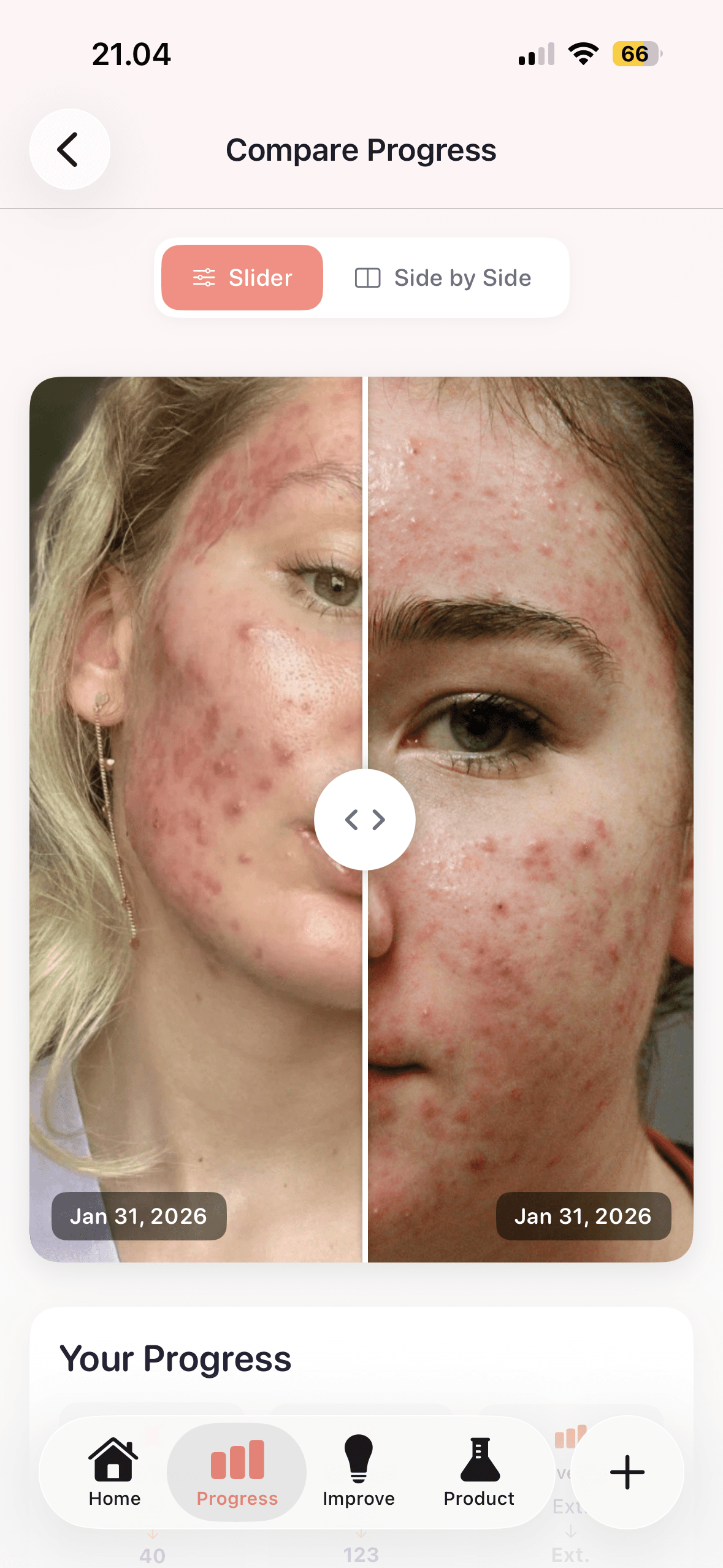
This is the problem Acnera was built for. The AI acne scan breaks your skin down zone by zone, and the before and after slider lines up your photos so you're comparing the same face at the same angle, not two random selfies.
If your acne seems to follow your sleep, stress, or cycle more than any product, read how sleep affects acne. Not every flare is about what's on your shelf.
Started a new active? The free acne treatment timeline calculator shows when the adjustment period should end and when to judge results.
Frequently asked questions
How long does skin purging last?
Most sources say around four to six weeks, roughly one cycle of skin renewal. If your skin is still getting worse after about six to eight weeks on the same product, it's unlikely to be purging. Check with a dermatologist or pharmacist.
What does purging look like?
Purging usually looks like your normal acne, arriving faster: small bumps, whiteheads, and blackheads in the areas where you usually break out. Large, painful, or deep bumps in new places point to a breakout or a reaction instead.
Can a moisturizer or sunscreen cause purging?
No. Purging requires an ingredient that speeds up skin cell turnover, such as a retinoid or an exfoliating acid. New pimples after a moisturizer, sunscreen, or makeup are a breakout, possibly from a pore-clogging ingredient.
Does niacinamide cause purging?
Niacinamide doesn't speed up skin turnover, so it shouldn't cause purging. If you break out after starting a niacinamide product, check the rest of its ingredient list and what else you started at the same time.
Does salicylic acid cause purging?
It can. Salicylic acid is a BHA that exfoliates inside the pore, so some people notice a short-lived increase in small spots when they start it. If spots keep increasing after several weeks, reassess.
Is purging a good sign?
Not necessarily. Some people never purge and still get great results, and research hasn't confirmed that retinoids cause an initial flare. Judge a product by where your skin is after six to eight weeks, not by whether it purged.
This article is for general education and isn’t medical advice. If your acne is severe, painful, scarring, or not improving, see a board-certified dermatologist.